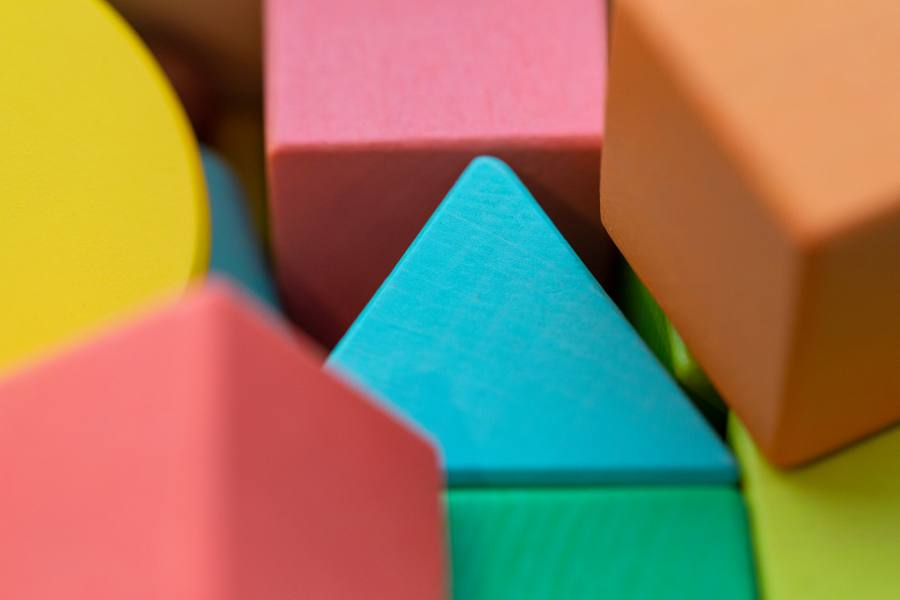
Temsili görsel (stok fotoğraf); ürünün kendisi değildir.
Matching Comes Before Naming
A toddler fits a shape into a hole long before they can name it, and the matching is the developmental work while the naming follows later.
That means a sorter is useful from well before a child could answer a question about triangles, and testing them on names misses what they are doing.
Naming shapes while a child plays supports the vocabulary without turning the toy into a quiz, which is the useful adult contribution here.
Too Many Shapes Is The Common Mistake
A sorter with a dozen shapes overwhelms a young toddler, who then abandons it, and three or four shapes is plenty at the start.
Sorters where a lid can be swapped, or shapes held back, scale with a child, and a fixed twelve-hole sorter suits a narrow window.
Starting with circle, square and triangle and adding complexity later is the pattern that works, and it is the opposite of buying the most featureful sorter.
Rotation Is The Actual Difficulty
A child frequently has the right shape at the right hole and cannot rotate it to the correct orientation, which is a spatial skill that develops separately.
Circles avoid it entirely, which is why they are solved first, and triangles and rectangles are considerably harder for that reason alone.
Recognising that a child is failing on rotation rather than on matching changes what help is useful, and pointing at the hole does not address it.
Retrieval And Frustration
A sorter where shapes drop inside and cannot be retrieved without adult help creates dependence and frustration in equal measure.
A hinged lid, an open base or a large opening lets a child empty and restart independently, which is what makes the toy self-sustaining.
That single design feature determines whether a sorter is played with alone or requires an adult every ninety seconds.
Size, Material And Mouthing
Shapes must be too large to swallow, and the standard test of whether an object passes through a toilet roll tube applies here as everywhere.
Wooden shapes are heavier, more satisfying and considerably louder on a hard floor than plastic, and neither is better on safety grounds if both are made properly.
Painted shapes chip under mouthing, and plain wood or a stated toy-safe finish is the safer specification for anything at this age.
Posting toys more generally are worth knowing about, since the underlying appeal is putting an object through a hole and out of sight, which is a developmental interest in its own right separate from shape matching. A simple box with a single round hole and a set of balls satisfies that completely and is frequently more popular than an elaborate sorter. Recognising which of the two a child is actually enjoying helps considerably in choosing what to offer next.
Shapes doubling as stacking blocks or bath toys extend the value of the set beyond the sorting, since a solid wooden shape is useful long after the box has been outgrown.
The Verdict
A classic toy that works well when the number of shapes suits the child and they can retrieve them independently.
Twelve-shape sorters overwhelm, trapped shapes create dependence, and rotation defeats children who can already match.
Start with three or four shapes. A twelve-hole sorter overwhelms a toddler and gets abandoned.
Bir bakışta
Artılar
- Matching works long before naming develops
- Self-correcting: a shape either fits or does not
- Simple sorters scale by holding shapes back
- Durable with nothing to break
Eksiler
- Too many shapes overwhelms young toddlers
- Trapped shapes require adult retrieval constantly
- Rotation defeats children who can match
- Painted shapes chip under mouthing
Sıkça sorulan sorular
How many shapes should it have?
Three or four to start. A dozen overwhelms a young toddler who then abandons it. Sorters with swappable lids, or where you simply hold shapes back, scale with the child as they get better.
My child has the right shape but cannot post it.
That is rotation, a spatial skill that develops separately from matching. Circles avoid it entirely, which is why they are solved first. Pointing at the hole does not help — turning the shape with them does.
What design feature matters most?
Independent retrieval. If shapes drop inside and need an adult to get them out, the toy requires help every ninety seconds. A hinged lid or open base lets a child empty and restart alone, which is what makes it self-sustaining.
Teknik Özellikler
| Type | Wooden shape sorter |
| Sequence | Matching first, naming later |
| Start with | Three or four shapes |
| Easiest | Circle, no rotation needed |
| Hidden difficulty | Rotating to the right orientation |
| Essential feature | Independent retrieval |
| Safety test | Shapes must not pass a toilet roll tube |
| Finish | Plain wood or toy-safe stated |
Özet
Start with three shapes, not twelve, and check the child can get them out again without you.
Amazon'da Fiyatı Kontrol Et